
Gaelic football betting before the throw-in: rules and county championships
Gaelic football is an Irish team game for two sides of 15, a goalkeeper and fourteen outfield players, played with a round leather ball weighing between 480 and 500 grams. It is governed by the Gaelic Athletic Association (GAA), established in 1884, and remains one of the few strictly amateur sports in the world.
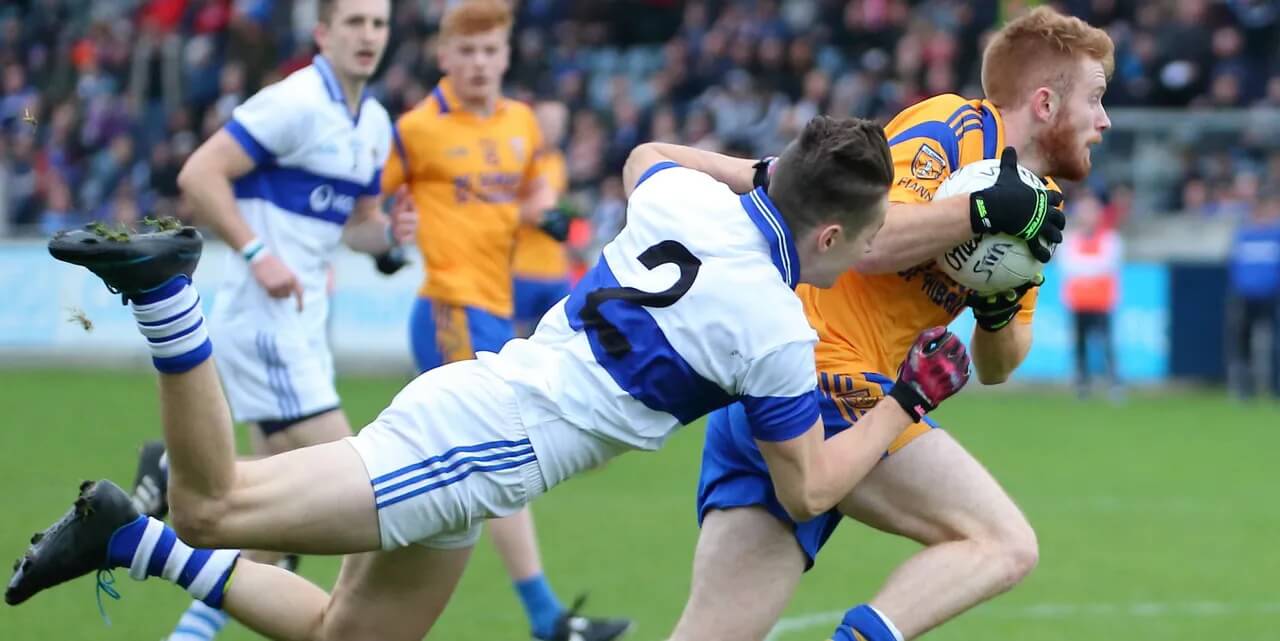
The ball can be kicked or played away with the fist or an open hand. A player holding it may take no more than four consecutive steps, and may bounce it once, and once again after each toe-tap, a move in which the ball is dropped onto the foot and kicked back into the hands. A ball on the ground cannot be picked up with the hands, except by the goalkeeper inside the small rectangle; outfield players lift it with the foot.
Goals, points and the two-point arc
Score | How it is made | Value |
|---|---|---|
Goal | over the goal line between the posts and under the crossbar | 3 points |
Two-pointer | kicked over the crossbar between the posts by a player with at least one foot on or outside the 40-metre arc, with no team-mate touching the ball | 2 points |
Point | over the crossbar between the posts from inside the 40-metre arc or the 20-metre line | 1 point |
The two-pointer began as a temporary change proposed by the Football Review Committee; a GAA Special Congress on 4 October 2025 made it permanent from 1 January 2026. Scores are written as goals, then points, and the side with the greater total of points wins: 1-10 is worth 13 points, so it beats 0-12.
Halves of 30 or 35 minutes
Normal time is two halves of 30 minutes, with time added in each half for delays. Inter-county senior championship and National League games are longer, two halves of 35 minutes each. If a knockout game is level at the end of normal time, extra time of two 10-minute periods may follow, provided the committee in charge has set this in advance.
The club season: county, province, All-Ireland
Each county runs a championship for its senior clubs. County champions move on to the provincial club championships of Connacht, Leinster, Munster and Ulster, and the four provincial winners meet in the All-Ireland Senior Club Championship, whose final is played in January.
Kerry county championship: run by the Kerry County Board since 1889, with divisional teams playing alongside clubs. The county final is in October. A winning club goes on to the Munster club championship; divisional sides cannot play there, so if one of them wins, the Kerry Club Championship winner represents the county. Dingle took the 2025 county title and then the All-Ireland club final on 18 January 2026.
Dublin club championship: first played in 1887, with 16 teams in four groups of four and the top two in each group reaching the quarter-finals. The winner represents Dublin in Leinster; Ballyboden St Enda's were the 2025 champions.
Mayo Championship group: the Mayo senior championship was first won by Castlebar Mitchels in 1888, and its champion goes on to the Connacht club championship. Ballina Stephenites won in 2025.
Gaelic football in the 1xBet pre-match line
Gaelic football groups are mostly named after an Irish county, often followed by the grade of the competition, as in “Antrim Senior Championship” or “Armagh Intermediate Championship”. The other disciplines are in the pre-match sports section, and you can sign up for an account in Algerian dinars (DZD) to bet on them.